



This article is part of Nuvama’s ongoing effort to foster clarity and transparency in an often complex and opaque investment landscape. Through this series, we aim to bring discerning investors closer to the insights, frameworks, and perspectives that drive long-term value. It also offers a window into how we think, how we invest, and the principles that shape our strategies, enabling a more informed and nuanced understanding of the opportunities we pursue.
Why India’s Private Equity Has Emerged as a Credible Alternative Investment
As Indian businesses scale and private markets deepen, private equity is moving from a niche allocation to a more established part of the alternative investment landscape.
Think of a business such as Haldiram’s. A household name built over decades is now large enough to attract institutional capital at a scale once associated mainly with listed companies. A USD 1.6 billion transaction involving Alpha Wave and Temasek in 2025 was among India’s largest PE deals of the year (1).
Haldiram’s is only one example of a broader shift. India’s investment story is no longer confined to its public markets.
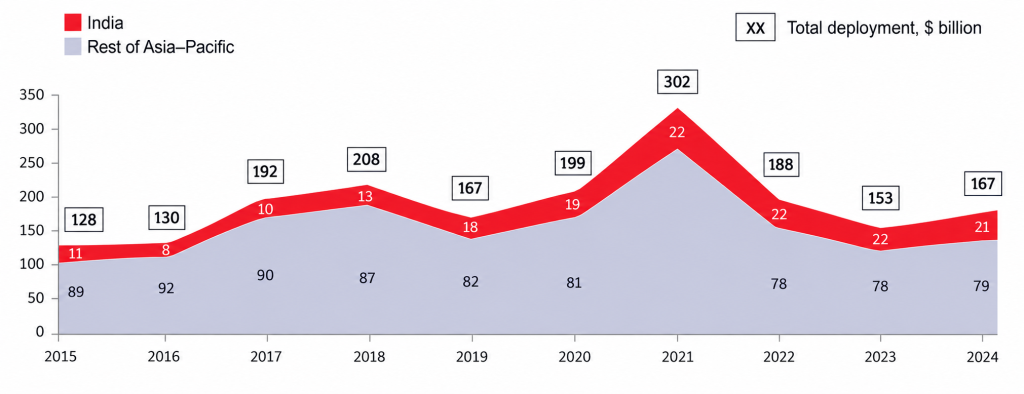
India’s private-capital deployment across asset classes reached around USD 44 billion in 2025, with private-capital intensity rising to 1.42% of GDP, more than twice the 0.68% average recorded between 2006 and 2015. India’s share of Asia-Pacific private equity and venture capital deployment also rose from about 12% in 2015-19 to 21% in 2020-24 (2). Greater China’s share declined from 55% to 37% over the same periods.
Exhibit 1: India’s share of Asia-Pacific PE/VC deployment has risen (3)
Share of Asia- Pacific private equity (PE) and venture capital (VC) deployment, 1%
Scale is only part of the story. As the opportunity set expands, the difference increasingly lies in how managers select businesses, deploy capital and ultimately return it to investors.
India’s structural growth story is creating a durable PE opportunity
What makes this opportunity particularly interesting is the breadth of India’s growth story. Private equity needs businesses with room to expand, and India increasingly has them across sectors.
Consumption is expanding, financial services are deepening, manufacturing is being reshaped by supply-chain diversification, and government capital expenditure is supporting infrastructure and industrial capacity. Moderating interest rates and relatively stable inflation add to the backdrop.
Reports expect domestic consumption, manufacturing and industrials, and financial services to remain among the areas attracting investor interest. Government capex, production-linked incentives and supply-chain realignment are adding to the opportunity.
The opportunity extends beyond finding the next high-growth company. Established businesses can also attract PE capital when they reach a point where additional capital, professionalization or acquisitions can support their next phase of growth.
Deal activity reflects this broadening. In 2025, India’s PE deal volume increased to 182 deals from 146 in 2024, even as average PE deal size fell from about USD 209 million to USD 118 million. Sub-USD 100 million PE transactions rose from 68 to 117 (4).
The broader deal mix suggests that a larger pool of mid-sized businesses is becoming investable. For managers, that creates more choice but also places greater weight on sourcing and identifying where capital and operational support can genuinely create value.
India’s relative position within Asia-Pacific is strengthening
The change becomes clearer when India is viewed against the wider Asian private-markets landscape.
According to a 2026 survey of more than 50 limited partners, India was the most attractive private-market destination in Asia-Pacific. Thirty-one percent of respondents ranked it first, while 76% placed it among their top three choices (5).
The trend has not been linear. India’s combined PE-VC investment value declined by about 17% in 2025 to approximately USD 36 billion, while pure-play PE investment fell about 33% (6). Tariff uncertainty, valuation gaps and tighter leverage contributed to a more cautious deal environment.
The environment is making manager discipline more important: what they buy, what they pay and how they expect to create and realise value.
The market is becoming more institutional and performance-driven
For years, India’s private equity story was largely about capital entering the country. The next phase is about what managers can do with that capital: how they select opportunities, support businesses and return capital to investors.
The number of funds active in India’s PE market has grown from roughly 100-110 in 2016 to around 170-180 in 2025. Around 90% of the top 30 global funds are now active in India. Domestic funds have also become more prominent, accounting for an estimated 50-55% of active investors in 2025 (7).
Competition for capital has consequently become tougher.
LPs are placing greater emphasis on track record, distributions and execution capability. For funds raised after 2019, first-quartile managers have raised successor funds at roughly 180% of their predecessor fund size, compared with around 75% for fourth-quartile managers.
Being in the private equity business is no longer enough.
Exhibit 2: LP interest among alternative asset classes (8,9)
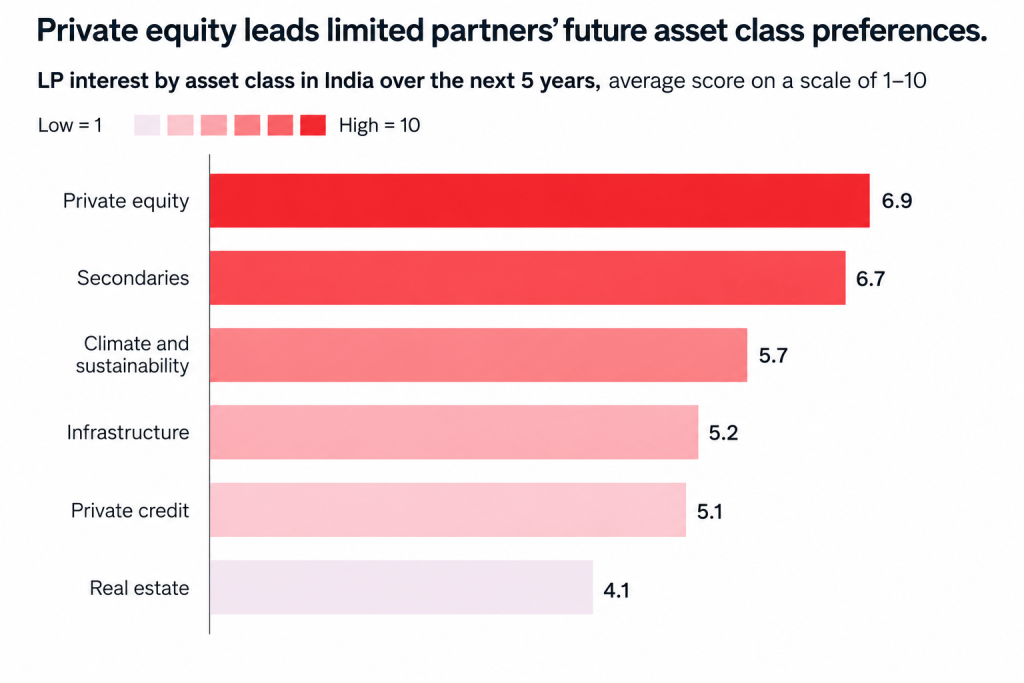
At the strategy level, buyout and growth equity received the highest enthusiasm scores among surveyed LPs for the next five years, at 7.8 and 7.7 respectively. Both strategies can give managers greater influence over the businesses they back.
India’s alternative investment ecosystem has grown alongside this institutionalization. As of March 2026, SEBI data showed total AIF commitments of INR 16.94 lakh crore, with INR 6.76 lakh crore in cumulative net investments. Category II AIFs, where private equity and private credit strategies are prominent, accounted for INR 12.74 lakh crore of commitments (10).
Private equity is therefore no longer operating at the edge of India’s financial system. It has become part of a much broader institutional investment ecosystem. But a mature PE market is tested at the other end of the investment cycle too: whether managers can convert value creation into actual distributions.
Exit markets are making the PE proposition more credible
There is a simple test for any investment strategy: can investors eventually get their capital back?
9. Note: Private equity includes the score for venture capital.
10. https://www.sebi.gov.in/statistics/1392982252002.html
For private equity, the question carries more weight because investments are held for several years and are not continuously traded on an exchange. A business can create substantial value, but investors ultimately need a route to realize it.
India’s exit ecosystem has consequently become an important measure of the market’s maturity.
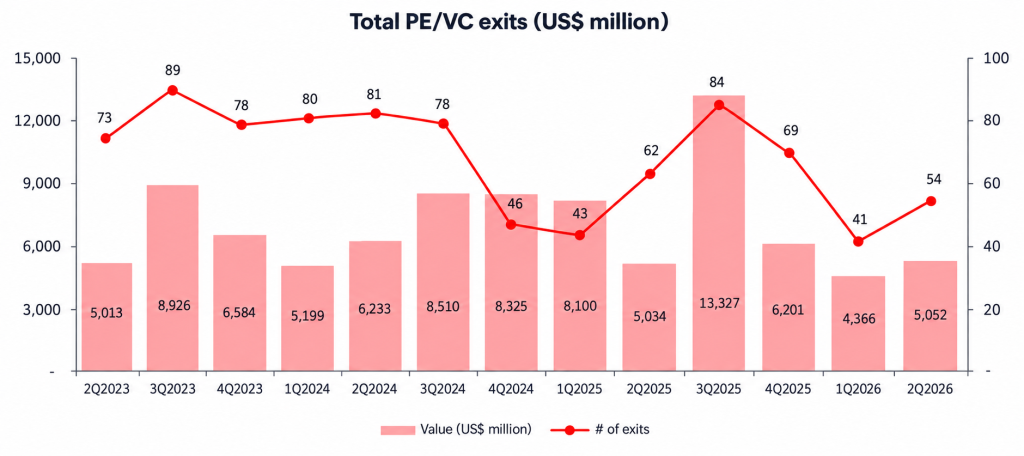
PE-VC exit value rose from about USD 33 billion in 2024 to USD 34 billion in 2025, even though the number of exits fell from 360 to 290. Buybacks and strategic sales accounted for a larger share of exit value, with strategic sales rising from around 16% to 21%.
One transaction illustrates the changing landscape. In 2025, Schneider Electric’s global parent acquired the remaining stake in Schneider Electric India from Temasek in a transaction valued at approximately USD 6.4 billion. It was India’s largest PE-backed exit of the year and was structured as a buyback (11).
The deal also shows that a PE exit does not have to depend on a stock-market listing. Strategic buyers, corporate consolidation, sponsor-to-sponsor transactions and secondary sales can all provide routes to liquidity. For managers, that means thinking about the exit from the point of entry, not only at the end of the holding period.
The first half of 2026 has been somewhat subdued, with PE/VC exits of USD 9.4 billion across 95 exits, down 29% year-on-year. Yet the routes to liquidity remain varied. Open-market exits accounted for 44% of exit value in 1H2026, followed by strategic exits at 36%. The quarterly data also shows how the mix can shift between open-market, strategic, secondary and IPO exits (12).
Exhibit 3: India’s PE exit market offers multiple routes to liquidity (13)
The return equation is becoming more visible
A stronger exit ecosystem also makes it easier to judge managers on realized outcomes rather than capital raised or deployed.
Analysis provides one measure of realized outcomes. The median IRR for Indian PE deals where exits have occurred rose from 18.0% for the 2008 vintage to 33.1% for the 2019 vintage (14).
That does not mean every PE investment delivers such outcomes. Nor does it remove the risks of illiquidity, valuation, leverage, execution or manager selection.
It does, however, show why private equity is increasingly being assessed as an institutional asset class, where realised outcomes depend not only on the opportunity set but also on the quality of the manager executing the investment.
From capital availability to quality of opportunity
India’s private equity market is entering a more selective phase. There are more managers in the market, domestic participation has increased and a wider pool of businesses can attract institutional capital.
The challenges remain. Valuation gaps persist, large transactions have slowed, currency movements can affect cross-border returns, and a significant amount of invested capital remains unrealized. Manager selection and the ability to exit investments remain critical.
The question for investors is therefore less about whether India can support a private equity ecosystem and more about which managers can identify the right businesses, create value during the holding period and realize that value at the right time.
That makes private equity different from simply taking exposure to India’s growth through listed markets. The investment is in the business itself, with the manager playing a more active role in how that business evolves.
Private equity still comes with a different set of risks and a longer investment horizon than traditional market investments. But as India’s private markets mature, the asset class is increasingly being judged on the quality of opportunities it creates and the outcomes it delivers.
That is what makes private equity a credible part of India’s growing alternative investment landscape.
This article is part of The NuTake — Nuvama Asset Management’s ongoing series on investment frameworks, market structure, and the evolving landscape of alternatives. If this perspective resonated, we invite you to explore the full series or speak with your Nuvama relationship manager.
Disclaimer
This document is for informational and educational purposes only and should not be regarded as an offer to sell or as a solicitation of an offer to buy or sell the securities or other investments mentioned in it. Recipients are advised to conduct their own research and seek professional advice before making any investment decisions. The document is prepared on the basis publicly available information, internally developed data and other sources believed to be reliable. All opinions, figures, charts/graphs, estimates and data included in this document are as on date specified therein or as on date and are subject to change without notice. The views provided herein are general in nature and do not consider risk appetite or investment objective of any particular investor; readers are requested to take independent professional advice before investing. This document is intended for the direct recipients only and should not be circulated without prior consent of Nuvama Asset Management Limited (“NAML”). The document is not directed or intended for distribution to or use by any person or entity who is a citizen or resident of or located in locality, state, country or other jurisdiction, where such distribution, publication, availability or use would be contrary views to local law, regulation or which would subject NAML and its affiliates to any registration or licensing requirement within such jurisdiction. The securities described herein may or may not eligible for sale in all jurisdiction or certain categories of investors. Persons in whose possession this document are required to inform themselves of and to observe such restrictions. Nuvama Asset Management Limited (“NAML”), it’s Holding Company, associate concerns or affiliates or any of their respective directors, employees or representatives do not assume any responsibility for, or warrant the accuracy, completeness, adequacy and reliability of such information or any direct, indirect, special, incidental, consequential, punitive or exemplary damages, including lost profits arising in any way from the information contained in this material. Whilst no action has been solicited based upon the information provided herein, due care has been taken to ensure that the facts are accurate, and opinions given are fair and reasonable. NAML is registered with Securities and Exchange Board of India as a Portfolio Manager vide Registration Number INP000007207 and acts as Investment Manager for various AIF schemes with registered office at 801- 804, Wing A, Building No. 3, Inspire BKC, G Block, Bandra Kurla Complex, Bandra East, Mumbai – 400 051. Corporate Identity No: U67190MH2019PLC343440.
0 comments